Case study · Live product
Kundli Milan — deterministic AI, shipped to consumers.
Sigma Tech India's flagship consumer product is a Vedic marriage-matching (kundli milan) app built on deterministic engines — the same birth details always yield the same result. 45+ engines score 100+ parameters across 8 Indian languages, and birth details are processed in memory then discarded. Nothing is stored.

matching engines
parameters scored
Indian languages
bytes stored
See it in action
A full compatibility report in seconds.
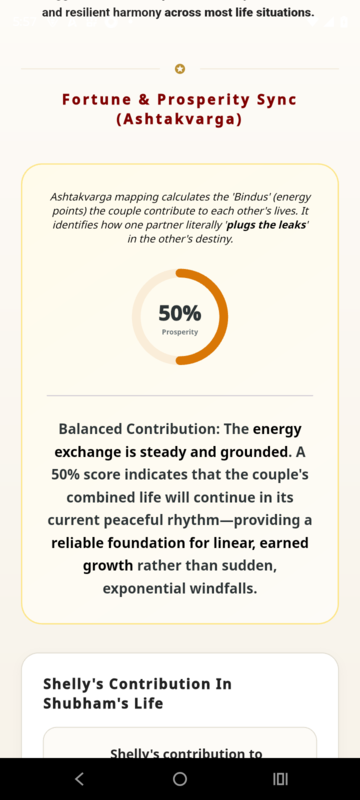
Real screens from the live app — tap any to enlarge.



How it works
Three deterministic steps, nothing stored.
Birth details in
Date, time and place of birth for both partners are entered on-device. Nothing is written to disk or a database — inputs live only in memory for the duration of the calculation.
45+ engines score 100+ parameters
Deterministic Vedic engines compute Ashtakoota (Guna Milan), Mangal Dosha, planetary strengths and dozens of compatibility axes. The same input always produces the same output — no randomness, no model drift.
Explainable report out
A structured, language-localised compatibility report is rendered in one of 8 Indian languages, then the in-memory birth details are discarded. Nothing to leak, nothing to breach.
Privacy by architecture
Zero-storage, in-memory processing.
Birth details — arguably the most personal data a matchmaking app can hold — are never persisted. They are processed in memory to produce the report and then discarded. There is no user database of birth charts to breach, sell or subpoena. This design is aligned with India's Digital Personal Data Protection (DPDP) Act principles of data minimisation and purpose limitation.