
Statement import with provenance
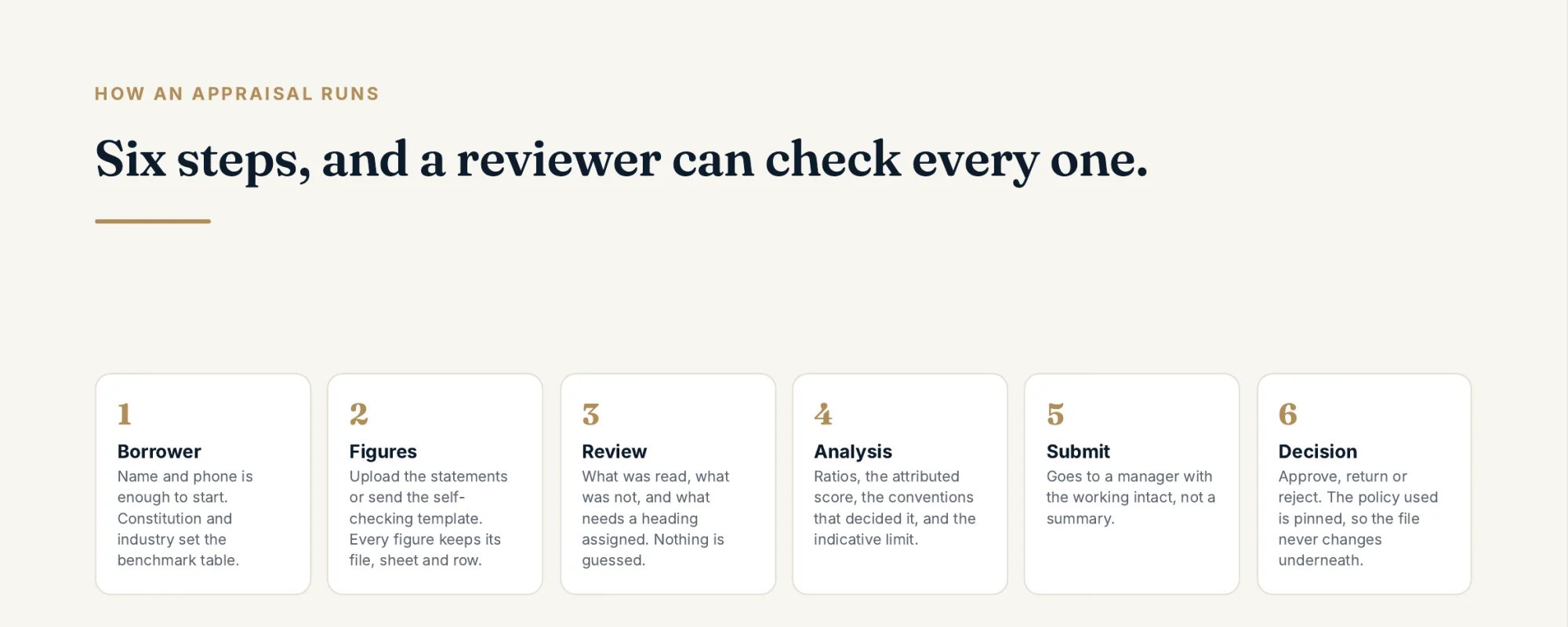
Read Excel, CSV, Word or PDF statements, or send the borrower a self-checking Excel template. Every figure keeps its file, sheet and row.
Credit appraisal software · Live
Sigma Banker is credit appraisal software that turns a borrower's financial statements into a reconciled, scored and fully traceable credit note — and refuses to answer rather than guess.
What is Sigma Banker?
An appraisal usually means re-keying statements into a spreadsheet and writing a note a reviewer has to take on trust.
Sigma Banker reads the statements, keeps every figure tied to the file, sheet and row it came from, works out ratios and limits against your bank's own policy, and writes a credit note a reviewer can take apart line by line. When the numbers don't add up, it says so — it never guesses.
Built for
What you get
How it works
Excel, CSV, Word or PDF statements — or send the borrower a self-checking template by link.
Every line is mapped with its source. Nothing is scored until the balance sheet balances.
24 ratios against your benchmarks, MPBF and Nayak limits, an attributed score and a convention check.
SWOT and credit note go to a manager to approve, return or reject — with the policy version pinned.
The appraisal engine
Nothing downstream runs on a balance sheet that does not balance.
Read Excel, CSV, Word or PDF statements, or send the borrower a self-checking Excel template. Every figure keeps its file, sheet and row.
No score until the balance sheet reconciles. A file that does not add up is flagged, not quietly rounded into a verdict.
Line items it cannot recognise are reported back for an officer to assign — never silently mapped to the nearest match.
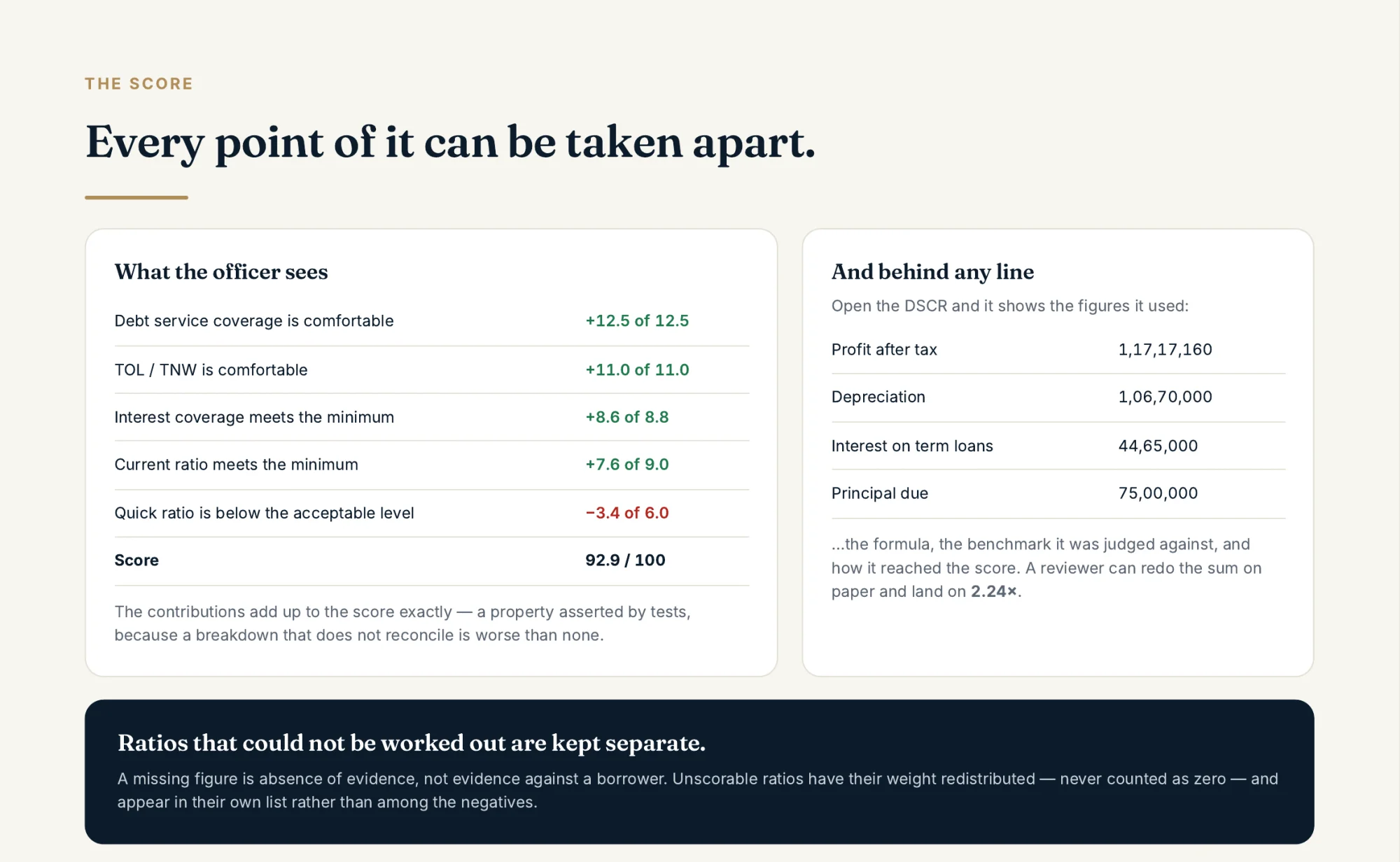
DSCR, TOL/TNW, current ratio, interest coverage and more — judged against the benchmarks your bank has set, not ours.
Working-capital limits by Tandon MPBF and the Nayak turnover method, side by side with the figures behind each.
Out of 100, with every point attributed to a ratio and a benchmark. Ratios that cannot be worked out are kept separate, never counted as zero.
What supports the proposal and what counts against it, with the evidence for each — written up as a printable credit note.
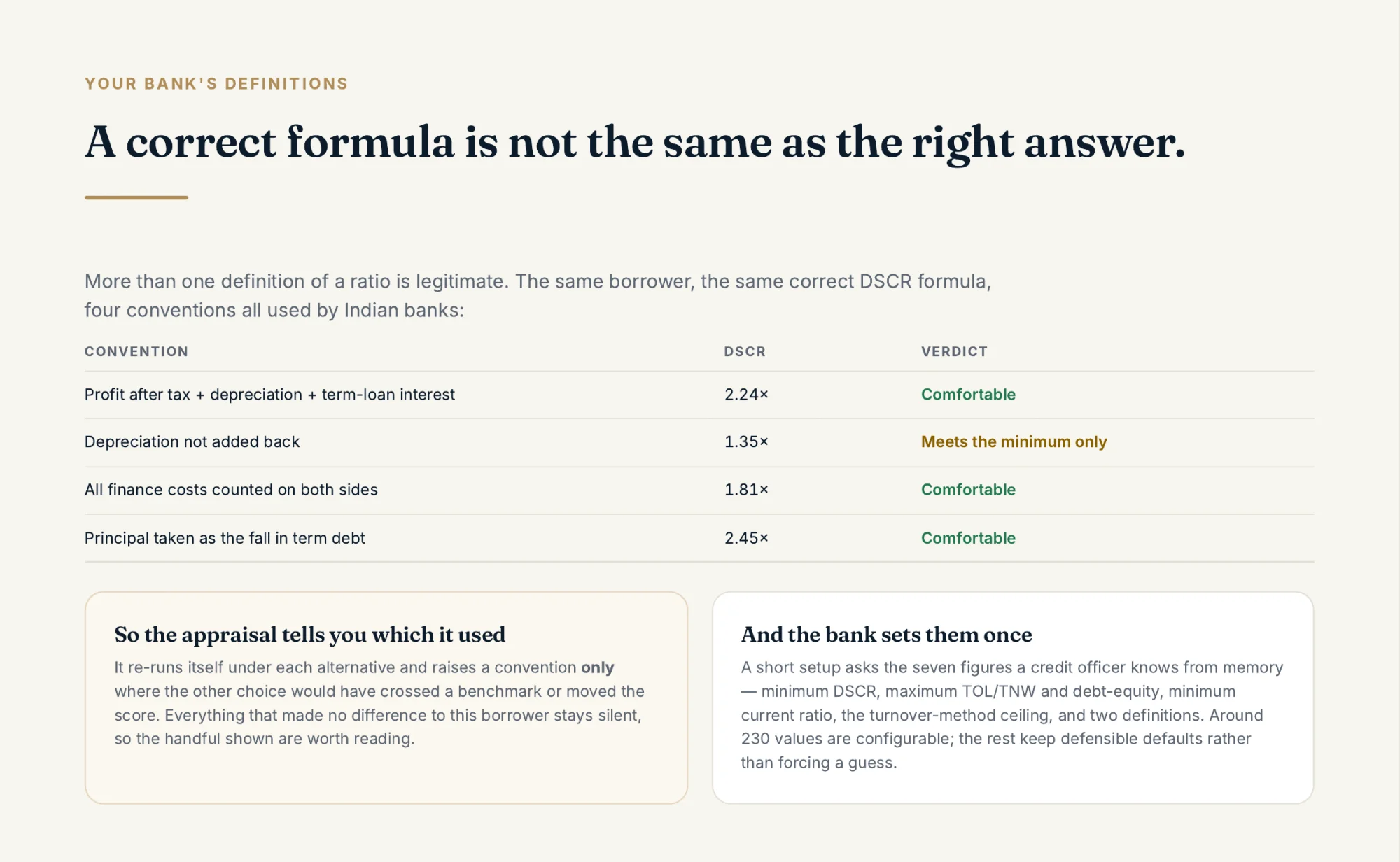
More than one DSCR definition is legitimate. The appraisal re-runs under each and tells you only when a different convention would change the verdict.
Seven setup questions a credit officer knows from memory. Around 230 values are configurable; the rest keep defensible defaults.
How an appraisal runs
The lending-policy version is pinned to the file, so the policy a decision was made under never changes underneath it.
Your bank's definitions
The same borrower and the same correct DSCR formula can give different verdicts under conventions all used by Indian banks. Sigma Banker tells you which one it used — and raises an alternative only where it would have crossed a benchmark or moved the score.
Your bank sets its definitions once: seven setup questions, around 230 configurable values.
Twenty-seven calculators
Rebuilt against current Indian rules and locked down with tests. Each calculation can be saved to a customer and exported.
Try the free public versions in the Banking Toolkit.
Where the data sits
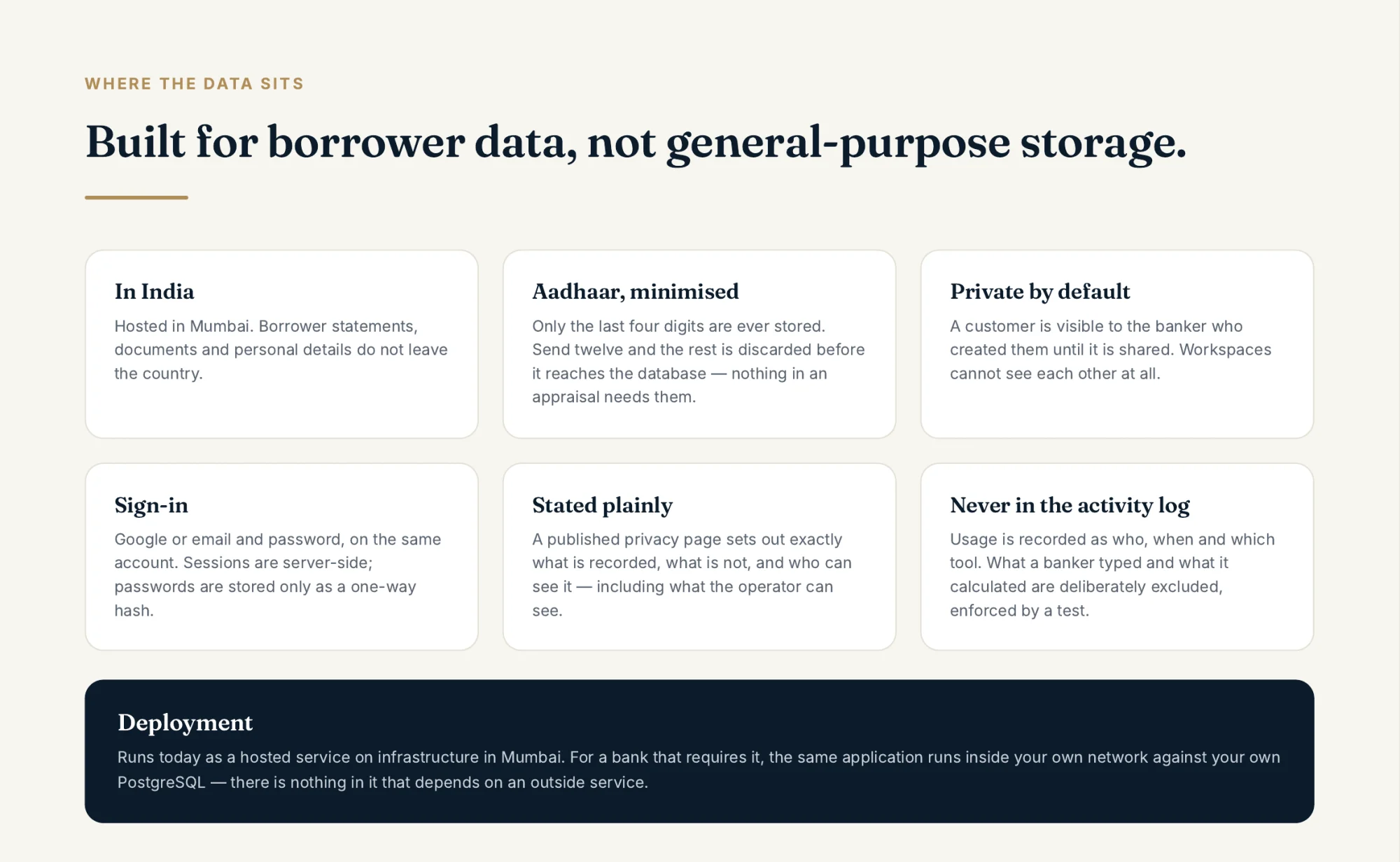
Six roles — admin, banker, manager, analyst, relationship manager, auditor — enforced on the server.
Why it's different
Tests assert that every figure quoted in prose can be re-derived from the workings.
Unbalanced files aren't scored and unknown headings aren't silently mapped.
Benchmarks and definitions are yours, and the version used is pinned to each file.
What we don't claim
It is a transparent, weighted comparison against benchmarks you configure. It has not been fitted to historical default outcomes, so it carries no probability of default.
The shipped thresholds are those commonly used in Indian bank appraisal. They are labelled as such and are yours to change.
The engine sets out the evidence for and against. The sanction is the officer's.
Sigma Banker is credit appraisal software for Indian bank officers, built by Sigma Tech India. It imports a borrower's financial statements, reconciles them, works out 24 ratios against your bank's benchmarks, sizes working-capital limits, produces an attributed score out of 100 and writes a printable credit note — with every figure traceable to the line it came from. It also includes 27 verified banking calculators.
Excel, CSV, Word and PDF. You can also send the borrower a self-checking Excel template through a document-request link — they upload without needing an account.
No. Reconciliation is a hard gate: the appraisal will not produce a score until the balance sheet reconciles, and line items it cannot recognise are reported back for an officer to assign rather than guessed.
Yes. A short setup asks seven figures a credit officer knows from memory, and around 230 values are configurable. Where more than one DSCR convention is legitimate, Sigma Banker tells you which it used and flags when another would change the verdict.
No. It is a transparent, weighted comparison against benchmarks you configure, with every point attributed. It has not been fitted to historical default outcomes. The engine sets out the evidence; the sanction remains the officer's.
In India — Sigma Banker is hosted in Mumbai. Only the last four digits of an Aadhaar number are ever stored, customers are private to the banker who created them by default, and the application can also run on-premise inside your own network.
A pilot starts with three real, already-decided credit files, checked line by line against what your credit officer wrote by hand.
A pilot begins with three real, already-decided credit files, checked line by line against what your credit officer wrote by hand. If the engine cannot stand next to that, you will see it.